Decoder-only transformers are the architecture behind GPT style language models. They stack causal Self-Attention blocks and are trained to predict the next token, so a single model handles generation, completion, and in-context learning.
Masked self-attention
- Masked self-attention is a variant of self-attention used in decoder-only transformers.
- The tokens that follow a given token within the sequence are “masked out” - no attention score is computed between the given token and the following tokens.
- This prevents looking forward in the sequence during self-attention.
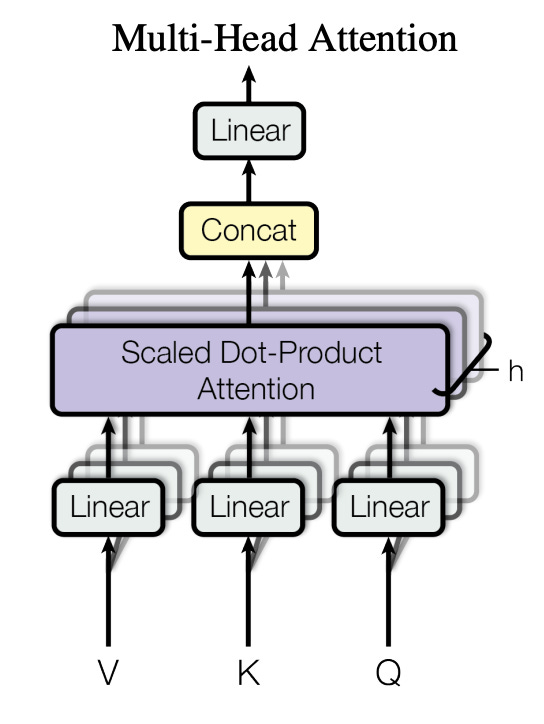
Multi-Head Attention
- Instead of using a single set of , we create independent sets, where each head has
- Here, and
- where is a learned projection back to the original dimension
- We use multi-head attention because it allows for the attending of multiple relevant parts of a sequence simultaneously, with multiple leraned subspaces
Causal Masking
Causal masking enforces autoregression: position may attend to positions only. It is implemented by adding to the attention logits above the diagonal before the softmax:
The masked entries become zero after softmax, so no gradient or information flows backward in time.
Next-Token Prediction
Training minimizes the cross entropy of the true next token at every position at once (teacher forcing):
Because the mask blocks future tokens, one forward pass yields supervised predictions, making training highly parallel over the sequence.
The GPT Block in PyTorch
A pre-norm block: LayerNorm, causal attention, residual, then LayerNorm, MLP, residual. einops.rearrange splits heads and torch.einsum computes the attention scores.
import torch
import torch.nn as nn
import torch.nn.functional as F
from einops import rearrange

class CausalSelfAttention(nn.Module):
    def __init__(self, dim, heads):
        super().__init__()
        self.h = heads
        self.qkv = nn.Linear(dim, 3 * dim)
        self.proj = nn.Linear(dim, dim)

    def forward(self, x, kv_cache=None):
        # x: (b, t, d)
        q, k, v = rearrange(self.qkv(x), "b t (three h d) -> three b h t d",
                            three=3, h=self.h)
        if kv_cache is not None:                    # append new k, v at inference
            k = torch.cat([kv_cache["k"], k], dim=2)
            v = torch.cat([kv_cache["v"], v], dim=2)
            kv_cache["k"], kv_cache["v"] = k, v

        scale = q.shape[-1] ** -0.5
        scores = torch.einsum("bhqd,bhkd->bhqk", q, k) * scale
        t_q, t_k = scores.shape[-2:]
        mask = torch.ones(t_q, t_k, device=x.device).tril(t_k - t_q).bool()
        scores = scores.masked_fill(~mask, float("-inf"))
        attn = F.softmax(scores, dim=-1)
        out = torch.einsum("bhqk,bhkd->bhqd", attn, v)
        out = rearrange(out, "b h t d -> b t (h d)")
        return self.proj(out)

class GPTBlock(nn.Module):
    def __init__(self, dim, heads, mult=4):
        super().__init__()
        self.ln1, self.ln2 = nn.LayerNorm(dim), nn.LayerNorm(dim)
        self.attn = CausalSelfAttention(dim, heads)
        self.mlp = nn.Sequential(nn.Linear(dim, mult * dim), nn.GELU(),
                                 nn.Linear(mult * dim, dim))

    def forward(self, x, kv_cache=None):
        x = x + self.attn(self.ln1(x), kv_cache)
        x = x + self.mlp(self.ln2(x))
        return x
KV Cache at Inference
During autoregressive decoding, keys and values for past tokens do not change, so recomputing them each step is wasted work. The KV cache stores and per layer and appends only the new token’s entries. See KV Cache.
Prefill vs decode
With a cache the model processes the whole prompt once (prefill), then feeds one token per step (decode) with of length 1. Note the mask above uses
tril(t_k - t_q)so a single query correctly attends to all cached keys. Cache memory grows linearly with sequence length and dominates long context serving; this motivates multi-query and grouped-query attention.